World’s Smallest Gasoline Engine
While I try to be very careful about posting hype masquerading as a legitimate technology breakthrough, this story is too good to pass up (even though it contains a lot of hype). I don’t know about the prospects for commercial success (as I have said before, I have been waiting for my DNA computer for 15 years) but this story is interesting and topical:
There is a copyrighted picture at the link showing the engine resting on a fingertip. Some excerpts from the story:
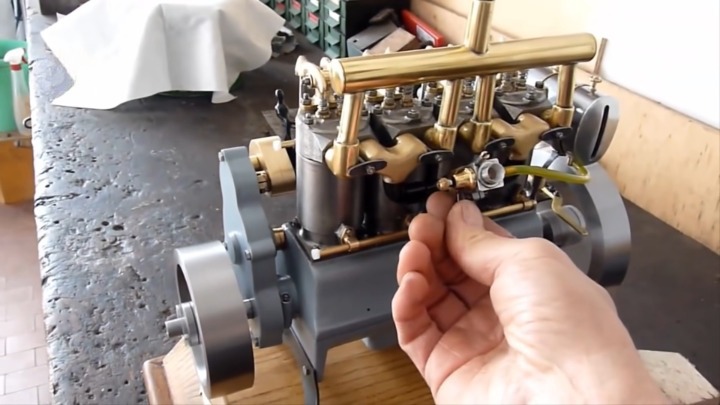
Scientists have built the smallest petrol engine — tiny enough to power a watch.
The mini-motor, which runs for two years on a single squirt of lighter fuel, is set to revolutionise world technology.
It produces 700 times more energy than a conventional battery despite being less than a centimetre long — not even half an inch. It could be used to operate laptops and mobile phones for months on end — doing away with the need for recharging.
Experts believe it could be phasing out batteries in such items within just six years.
I guess that depends on the prospects for mass production. If it takes a team of scientists and engineers to build each one, it won’t be replacing batteries any time soon. And the article mentions nothing about the difficulty of manufacture.
The engine, minute enough to be balanced on a fingertip, has been produced by engineers at the University of Birmingham. Dr Kyle Jiang, lead investigator from the Department of Mechanical Engineering, said: “We are looking at an industrial revolution happening in peoples’ pockets.
“The breakthrough is an enormous step forward.
“Devices which need re- charging or new batteries are a problem but in six years will be a thing of the past.”
Other applications for the engine could include medical and military uses, such as running heart pacemakers or mini reconnaissance robots.
Hmm. Not sure I want a combustion engine operating next to my heart, especially in light of:
One of the main problems faced by engineers who have tried to produce micro motors in the past has been the levels of heat produced.
The engines got so hot they burned themselves out and could not be re-used.
The Birmingham team overcame this by using heat-resistant materials such as ceramic and silicon carbide.
Anyway, regardless of whether it pans out, it is an interesting story and a neat technological achievement.
- For those who want an inside edge in the energy sector.
- Written by veteran energy analysts and insiders with a track record of accurately predicting trends.
- 100% FREE!
- And Much More...
Upcoming Events
Energy Investment Forum
June 10-11, 2013 - San Francisco, CA
A Case of Renewables versus Natural Resources
June 10-11, 2013 - San Francisco, CA
Columns
Comments
-
It is also essential that the analytical community, such as ITIF, start to act more like Bob Woodward and less ...
By Cl1ffClav3n on The Impact of Budget Sequestration on DOD Energy Innovation -
The above litany is an example of believing the myth instead of digging up the reality. When the government ...
By Cl1ffClav3n on The Impact of Budget Sequestration on DOD Energy Innovation -
I've been posted to that base, and others across Canada. Those aren't photo-voltaic cells, they are solar water heating, ...
By S'toon on How Not To Go Solar -
The invocation of the "defense industry" vice an alternative use of the "American people" in the closing paragraph is telling. ...
By ben on The Impact of Budget Sequestration on DOD Energy Innovation -
Fossil fuel power plants already have high-efficiency power storage--in their coal stockyards and tank farms--i.e., in their fuel. The ...
By Cl1ffClav3n on The Key to Running the World on Solar and Wind Power -
The move in natural gas should come from exports given the prevailing price in many foreign markets seeking supplies. ...
By ben on Who Wins from Rising Natural Gas Prices? -
Interesting to watch natural gas prices. I am surprised they have risen so much. An interesting topic: Should the ...
By Benjamin Cole on Who Wins from Rising Natural Gas Prices?


Why is there only one picture? Without some macro pics, the article is just words.
You say you’re worried about how it says it burns out. The article clearly says that that was the problem with previous engines, a problem that was solved with this one
No. He is worried about the heat that burns the engine out. The heat itself is a problem.
It is claimed that the heat problem is solved by using heat-resistant materials. So for the pacemaker you have this piece of hot ceramic and silicon carbide inside your chest. The device will need oxygen to burn the fuel and will produce hot exhaust gases. So there are two holes in your chest and under your clothes for intake and exhaust, plus some way to refuel the device. And, unless there is a battery for buffer, the little engine will have to run continuously, including in the shower. So I think we can discount the pacemaker application.
I do wonder about the fragility of such a small engine, and whether it could take the rough handling that batteries do. Shock mounting could overcome much of normal rough handling, but if employed in children’s toys, games and other devices, it may be just too fragile. Another concern is, what happens with the exhaust from this little engine? That could really limit it’s usage in many applications!
wait until the enviroWacos start complaints and lawsuits…